The white wafer inside an HCG vial breaks apart easily if you treat it roughly. Lyophilized human chorionic gonadotropin is a fragile glycoprotein, not a tough salt you can dissolve by shaking. Blast that wafer with a fast stream of water, or shake the glass hard, and you damage the protein before your first draw. Mixing HCG cleanly comes down to three habits: run water slowly down the glass wall, swirl gently until clear, and pick a liquid that fits your schedule.
Getting Your HCG Powder and Water Ready
Choosing Bacteriostatic Water Over Saline
USP bacteriostatic water (0.9% benzyl alcohol) is the right choice whenever a vial stays in use over multiple weeks. That small drop of benzyl alcohol stops bacteria from growing after the needle pierces the rubber stopper again and again. Preservative-free sterile saline (0.9% sodium chloride) and plain sterile water work the opposite way. Many single-shot trigger kits pack plain water or saline because the whole vial gets used right away. Those liquids hold nothing to fight bacteria. Once you push one into the powder, the clock starts immediately, and any leftover liquid in the vial has to go straight into the bin.
How to Reconstitute HCG Step by Step
- Wash your hands with soap and lay out your vials, 70% isopropyl alcohol wipes, one larger mixing syringe, and fresh U-100 insulin syringes on a clean counter.
- Pop both plastic caps off, swab each rubber stopper with a fresh alcohol pad, and wait until dry.
- Pull air into the mixing syringe equal to your target water volume, push it into the bacteriostatic water vial, and draw the exact mL needed.
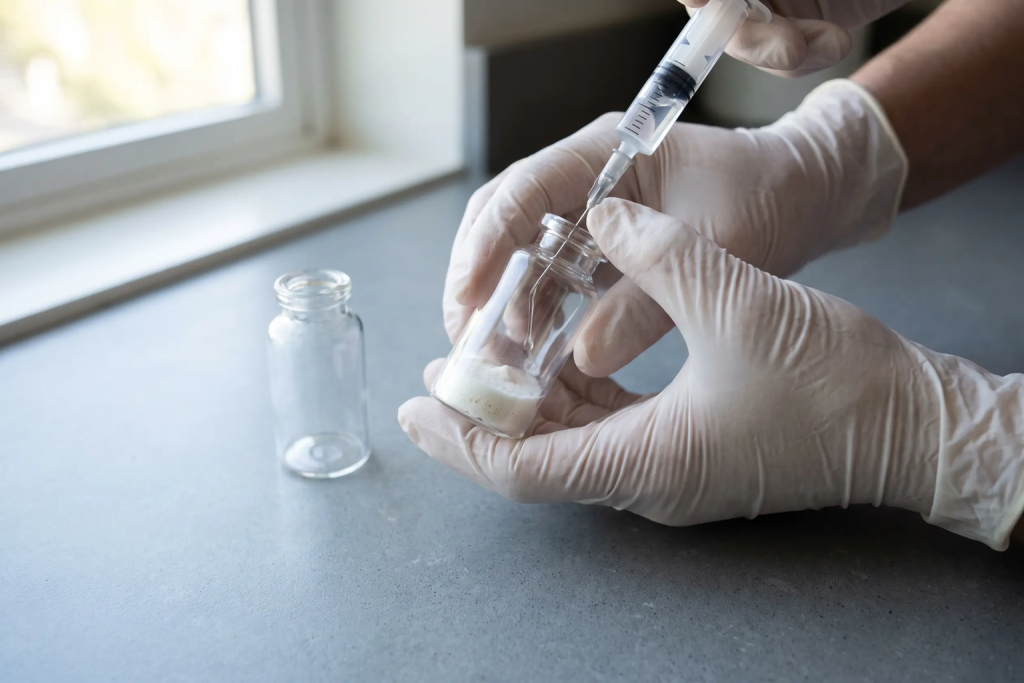
- Pierce the HCG stopper at roughly 45 degrees so water trickles down the glass wall instead of hitting the powder puck.
- Remove the mixing needle, drop it straight into a sharps bin, and gently swirl or roll the vial between your palms.
- Hold the glass up to a light and check that every speck has dissolved into a clear liquid with no foam.
How to Clear Air Bubbles From Your Syringe
Tiny air bubbles inside your syringe are normal and easy to fix, unlike thick foam from shaking, which ruins the protein. Vacuum inside a sealed vial causes plunger snap-back, so match injected air to the volume you draw, or vent excess vacuum first. Always draw slowly with the needle tip under the liquid. Point the needle straight up, tap the barrel so bubbles rise, and push that air back into the vial before setting your final mark.
How Much Water to Add to a 5,000 IU Vial
Adding more water does not make a vial weaker, and adding less does not make it stronger. A 5,000 IU vial holds 5,000 IU total whether you mix in 1 mL, 2 mL, or 5 mL. Water volume only sets how concentrated each mL becomes. Glass size also sets a hard ceiling: standard 3 mL to 5 mL vials physically cannot fit 10 mL of liquid. When reconstituting HCG, protocols using research grade 5000 IU HCG peptide vials rely on public lot-tested COAs to confirm exact IU strength before choosing a 1 mL, 2 mL, or 5 mL dilution.
| Water Added | Concentration | IU per U-100 Unit | Common Draw Marks |
|---|---|---|---|
| 1 mL | 5,000 IU/mL | 50 IU/unit | 250 IU = 5 units, 500 IU = 10 units |
| 2 mL | 2,500 IU/mL | 25 IU/unit | 250 IU = 10 units, 500 IU = 20 units |
| 5 mL | 1,000 IU/mL | 10 IU/unit | 250 IU = 25 units, 500 IU = 50 units |
Remember that IU measures biological potency, while U-100 units measure volume inside the syringe barrel. Mixing with 2 mL or 5 mL gives wider tick marks on a U-100 syringe than a tight 1 mL mix, which makes measuring easier and cuts dead-space waste inside the needle.
Keeping Reconstituted HCG Sterile in the Fridge
Every draw after mixing needs two clean habits: wipe the rubber stopper with a fresh alcohol pad, and use a brand-new syringe every single time. Write the mix date and concentration in IU/mL straight onto the vial label before storing it. HCG mixed with bacteriostatic water stays stable in the fridge at 2 to 8 °C (36 to 46 °F), kept away from light, for 30 to 60 days depending on manufacturer and diluent guidelines. Never freeze a mixed multi-dose vial, because freezing damages the glycoprotein, and throw the vial out immediately if the liquid turns cloudy, changes color, or shows floating specks.